
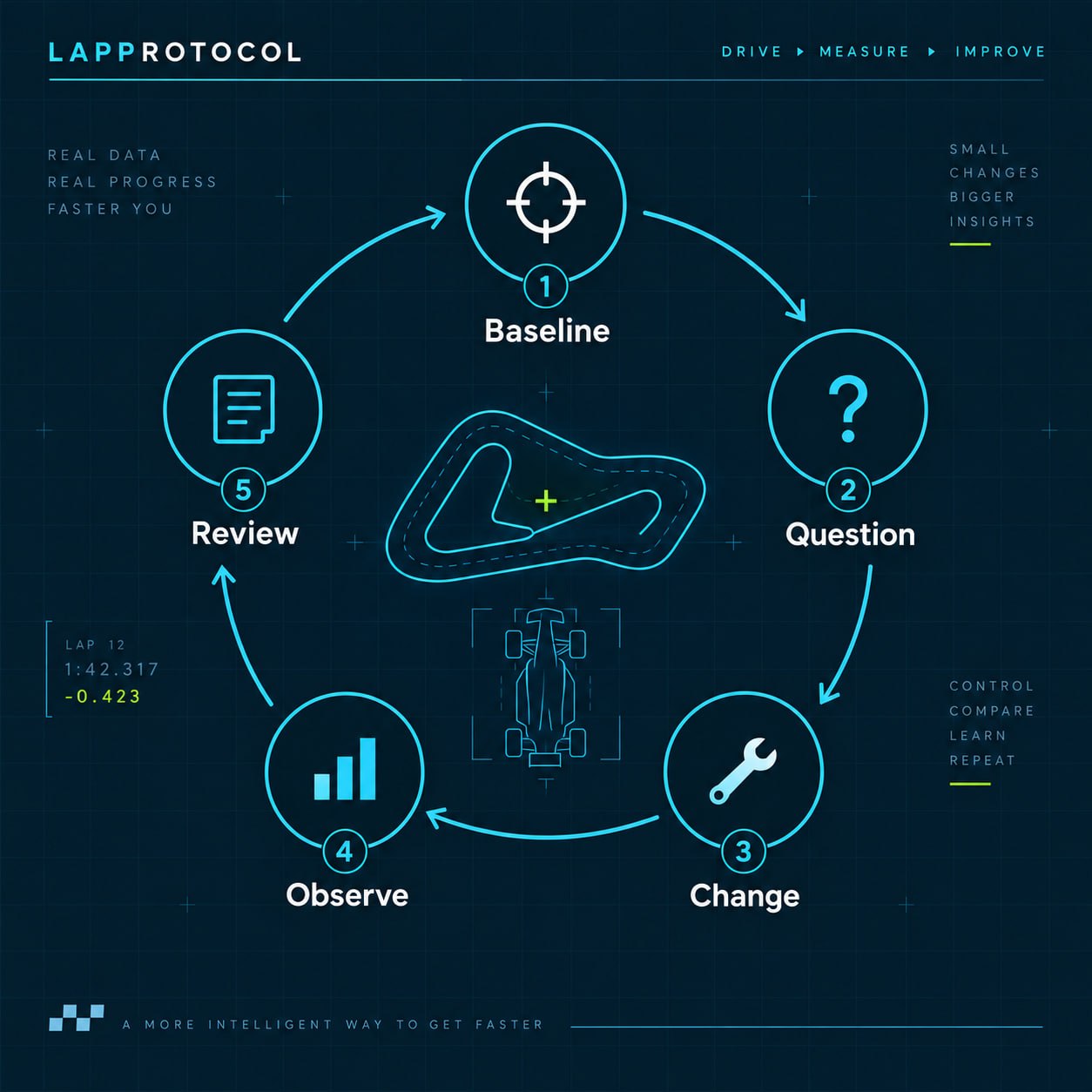
A track day can produce a lot of laps and very little knowledge. You may return with a faster time, a changed tyre pressure, a new damper setting and a strong feeling that the car is better. If several things changed while the weather, traffic and tyre state also moved, it can be difficult to say what actually happened.
A structured track test is not a professional race-engineering programme. It is a practical owner-driver habit: give each useful session a defined question, record enough context to know what “before” meant, make one bounded change where practical, and review the result without pretending the circuit is a laboratory.
The central sequence is:
baseline → question → one controlled change → observation → review
It fits the wider LapProtocol method:
symptom → measurement → interpretation → controlled change → validation
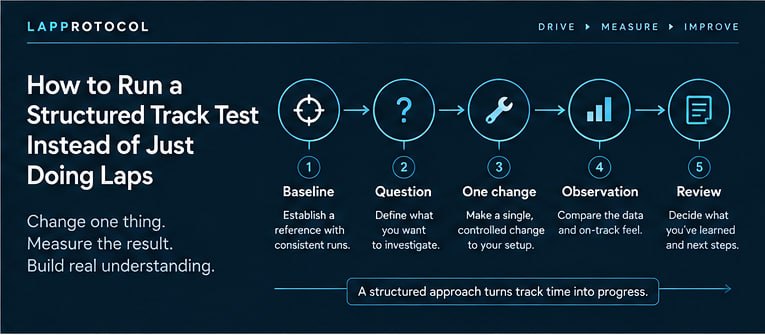
Stop treating every session as another batch of laps
“Do more laps” is not a test plan. Laps are the raw material. The learning comes from deciding what to observe and what would count as evidence before the run.
That does not mean every session needs a stopwatch target or a spreadsheet full of numbers. It means the driver should be able to answer three simple questions afterwards:
- What were we trying to learn?
- What changed, and what was observed?
- What remains uncertain?
A session can still be useful when the answer is inconclusive. Rejecting a hypothesis, discovering that traffic masked the result, or finding that a symptom is not repeatable is progress if it is recorded honestly.
Start with one question
Begin with a question specific enough to test. “Make the car better” is too broad. “Is entry understeer repeatable at the same corner during brake release?” is more useful because it identifies a location and phase. “Does a smoother brake release alter that symptom while entry speed and line remain broadly similar?” is a possible next question.
Other useful questions might be:
- Is the tyre-pressure pattern repeated under similar session conditions?
- Does a particular driver-input change alter the symptom?
- Does one setup change affect the expected phase of the corner?
- Does rear movement appear only when crossing a particular kerb?
- Does the reported delay before throttle occur every lap or only after several laps?
A question is not a conclusion. It is a request for evidence. Avoid writing the answer into the question, such as “Will the stiffer setting fix the understeer?” Start with what can be observed and what result would support or weaken the hypothesis.
Establish a baseline
Before changing anything, define what the car currently does. Record the minimum useful context for the question:
- vehicle identity and relevant configuration
- tyre model, condition and session history
- cold and post-session pressures, using a consistent method where relevant
- suspension or alignment settings that matter to the question
- fuel, passenger or other load
- ambient and track conditions, including rain, drying or surface changes
- session length, traffic, flags, cool-down laps and interruptions
- driver notes, video and available telemetry
- physical observations such as damage, wear, leaks or loose components
The baseline is not a perfect fixed state. It is a description of the conditions under which the observation was made. NASA Speed News’ practical HPDE guidance is useful context for carrying a gauge, checking promptly after a session and recognising that ambient and track conditions change. The cold-to-hot tyre-pressure method explains how to keep those readings separate from a universal target, while the pressure worksheet performs only the recorded subtraction.
If a safety-critical problem appears, stop treating it as an experiment. Inspect it and follow the relevant vehicle, tyre, brake, wheel or suspension instructions before continuing.
Decide what to record
Use a record that can be completed at the circuit. A useful structure is:
- objective or question
- baseline
- change
- conditions
- driver feedback
- data and measurements
- result
- confidence
- next question
“Confidence” does not mean a feeling of certainty. It describes how strongly the result supports the current interpretation. A repeated observation in comparable conditions may be more persuasive than a single dramatic lap, but neither automatically proves a cause.
For tyre records, identify the corner, gauge, unit and timing. For telemetry, record which channels were actually available and whether they were aligned well enough to compare the same phase. MoTeC i2 and Race Technology documentation describe product-specific comparison and graphing capabilities, but a product name does not establish that your logger, vehicle integration or licence supplies every channel.
Run the baseline session
The first session is for observing the existing behaviour, not for proving that a change worked. Drive within a familiar, safe margin. Avoid adding setup changes before you know how the car behaves in the current state.
Use the same corner, line or segment where practical. Repeat enough to discover whether the symptom is consistent, while recognising that a busy track may make clean repetition impossible. Note the lap, corner and phase rather than relying on memory at the end of the day.
Improve vague feedback while it is still fresh. “The car feels bad” is a starting signal, not a diagnosis. More useful observations might be:
- understeer begins during brake release
- rear movement appears only over a particular kerb
- throttle must be delayed at one corner
- balance changes after several laps
- the steering correction occurs before the apex, not at the exit
Driver feedback is evidence and context. It is not a diagnosis by itself. The corner-entry understeer method shows how to keep the driver’s report, measurable response, possible causes and discriminating test separate.
Review feedback and data together
Review the baseline before deciding what to change. Put the driver note beside the available evidence:
- driver feedback and video
- speed, throttle, brake, steering, acceleration, yaw, wheel-speed or GPS channels where available
- cumulative delta or segment time for the relevant section
- tyre and pressure records
- physical inspection and visible wear
- traffic, weather, load and session history
The two-lap telemetry method is useful when a comparison exists. It starts by locating where time changed, then checks the input and response sequence. A delta can locate a difference but cannot prove its cause. One channel can be misleading, and a faster lap does not mean every action on that lap was better.
Use the same discipline for setup observations. If the driver reports that throttle was delayed, ask what happened before that delay. Did brake release, steering, speed, path or yaw change? If a pressure pattern changed, was the measurement timing comparable? If the car moved over a kerb, was the same kerb taken at a similar speed and angle? These questions narrow the interpretation without manufacturing certainty.
Hand the record to the next review
The session record is the bridge between what happened at the circuit and what you inspect later. Before opening a trace, carry forward the same question, reference corner or segment, lap or run identity, conditions and known interruptions. Then state which evidence is actually available: driver note, video, pressure record, telemetry channel, physical observation or no usable measurement.
The Track-Test Session Record Worksheet is the existing tool owner for recording that context. The Telemetry Data Quality Checklist is a separate gate for deciding whether two laps are comparable enough to interpret, while the two-lap telemetry method explains how to locate a time change and form a testable interpretation. These pages answer different parts of the same workflow; one record should not be treated as proof that the next page’s evidence requirements have been met.
A useful handoff contains four explicit statements:
- Question: which corner, phase or decision is being reviewed?
- Evidence: which records exist, and which are unavailable, unrecorded or not validated?
- Interpretation: what observation is supported, and what remains a hypothesis?
- Validation: what comparable observation would strengthen or weaken that interpretation, or is the correct conclusion that no further change is justified?
If the handoff cannot identify a comparable next observation, keep the result unresolved. Do not fill the gap with a setup value, a product choice or a faster-lap claim. If the record contains a credible concern about brakes, tyres, wheels, suspension, steering or structure, the handoff becomes an inspection or escalation decision rather than another test step.
Turn the review into one hypothesis
A hypothesis connects an observation to a possible explanation and a test. For example:
“Entry understeer appeared in the early release phase at Turn 4 in three comparable laps. The next run will use a smoother brake release with a similar entry speed and line. Support would be less steering correction and a more consistent path through the linked exit. If the symptom remains, the hypothesis is weakened, not disproved for every condition.”
This is better than “the front needs more grip” because it names the phase, the proposed input, the comparison and the evidence that matters. It also avoids assuming that a setup direction is the answer.
Write down what result would weaken the hypothesis before making the change. Otherwise, it is easy to reinterpret any result as confirmation. A lower minimum speed, an earlier throttle trace or a faster final lap can each be misleading when viewed without the complete segment and context.
Change one meaningful variable
Where practical, change one meaningful driver input or setup variable. This reduces unnecessary variables and preserves attribution. Record exactly what changed, how it was changed and what stayed the same.
Perfect isolation is not possible at a track day. Weather changes, traffic appears, the driver adapts and tyres accumulate heat history. Some components and settings interact, so separating them perfectly may not even describe how the car works. Safety may also require multiple corrections at once. A damaged tyre, loose wheel or failed component is not a one-variable experiment.
The principle is therefore practical, not absolute: make the smallest safe and meaningful change that answers the question, and record when strict isolation was not possible. If a setup change requires lifting the vehicle, removing a spring, changing alignment or working on brakes, follow the relevant instructions and use competent inspection or installation.
Repeat and validate
After the change, repeat the same observation where conditions allow. Keep the question visible. Record what happened rather than only whether the final lap was faster.
Validation may mean:
- repeating the change on another comparable run
- returning to the baseline setting where safe and practical
- comparing the same corner and linked exit
- checking whether the driver’s report changed as well as the trace
- recording whether the result was masked by traffic or weather
A result that appears once is a lead. A pattern repeated under similar conditions is stronger. Reversing a change can help, but it is not always safe, practical or informative if the conditions have moved too far. State what remains uncertain.
The wheel-rate and motion-ratio explanation is a useful example of keeping a calculation separate from a setup prescription. A calculated quantity can sharpen a question, but it does not tell you that a particular change is appropriate for a particular car.
Account for changing conditions
Track testing is full of variables that cannot be held constant:
- ambient and track temperature
- rain, drying lines and changing grip
- traffic, flags and clear-track availability
- tyre age, heat history and pressure timing
- fuel level, passenger or equipment load
- session length and driver fatigue
- driver adaptation as a new input becomes familiar
- track state, rubber, debris or surface change
Record these conditions so the interpretation remains conditional. Do not claim that a setting caused an improvement when the comparison also included a cooler track, fresher tyres and a clear lap. That does not make the result useless. It tells you what needs repeating before confidence should increase.
Representative four-session test structure
The following is a representative structure, not a mandatory track-day programme:
Session 1 - Baseline
Establish the behaviour, record the conditions and capture the driver’s description. Do not make the experimental change first.
Session 2 - Controlled test
Change one defined driver input or setup variable where practical. Keep the question, corner and review measure visible.
Session 3 - Confirmation
Repeat the comparison, or reverse the change where safe and meaningful. Record what stayed different from the baseline.
Session 4 - Refine
Only refine the question or change if the previous evidence justifies it. If not, stop and review the uncertainty instead of accumulating adjustments.
The number of sessions may be smaller or larger. An event schedule, weather, mechanical issue or safety requirement may end the test early.
Common testing mistakes
- Starting with a setup change before recording the baseline.
- Asking a question too broad to produce an observable answer.
- Changing several setup variables, tyre pressures and driving inputs together.
- Treating one-variable-at-a-time as an absolute rule despite safety or interaction.
- Comparing laps with different traffic, tyre state, weather or load without recording it.
- Treating driver feedback as either infallible diagnosis or irrelevant opinion.
- Treating one telemetry channel, one pressure reading or one lap time as proof.
- Using a faster final lap to declare every corner improved.
- Ignoring the linked exit because the entry trace looked better.
- Continuing after a physical fault because the test plan is not finished.
- Turning a representative plan into a universal track-day programme.
- Recording so much data that the driver cannot complete the record consistently.
End the day with a review
Before leaving, write a short conclusion while the day is still clear. State the original question, baseline, change, conditions, observation, confidence and next question. Separate what was documented from what was inferred.
For example: “The throttle delay at Turn 7 appeared in the baseline and test runs, but the test run also had cooler tyres and more traffic. The driver still reported the same wait, while the exit speed comparison was incomplete. Confidence that the symptom is repeatable is conditional. The next question is whether it remains with comparable tyre state and a clean run.”
That conclusion is useful even though it does not prescribe a fix. It tells the next session what to repeat and what not to assume.
Practical checklist
Before the car goes out:
- Define one question and the phase or location it concerns.
- Record the vehicle, tyres, pressures, setup, fuel/load and conditions.
- Identify available telemetry and its limitations.
- Confirm the car is mechanically safe and event-compliant.
After the baseline:
- Record driver feedback as an observation, not a diagnosis.
- Review the relevant data, tyre records and physical observations together.
- Write the hypothesis and what would support or weaken it.
- Choose one smallest safe meaningful change where practical.
After the test:
- Record what changed and what stayed the same.
- Repeat or reverse the comparison where practical.
- Include the linked segment, not only the first visible gain.
- State the confidence and the next question.
Sources and methodology
This article reuses a small set of existing source records. NASA Speed News provides practical HPDE context for pressure checks and changing conditions. MoTeC i2 and Race Technology documentation provide product-specific context for available telemetry and comparison views. Driver61 provides specialist context for turning an understeer report into a more specific observation. These sources do not establish a complete owner-driver test-day programme.
The structured sequence, record template, one-variable principle with exceptions, hypothesis framing and combined data-plus-feedback method are LapProtocol editorial methodology. They are not presented as professional race-engineering practice, and LapProtocol does not claim hands-on testing or invented vehicle results.
The LapProtocol methodology page gives the broader distinction between observation, measurement, interpretation, controlled change and validation. This article applies that distinction to an ordinary track day while preserving uncertainty when conditions cannot be controlled.