
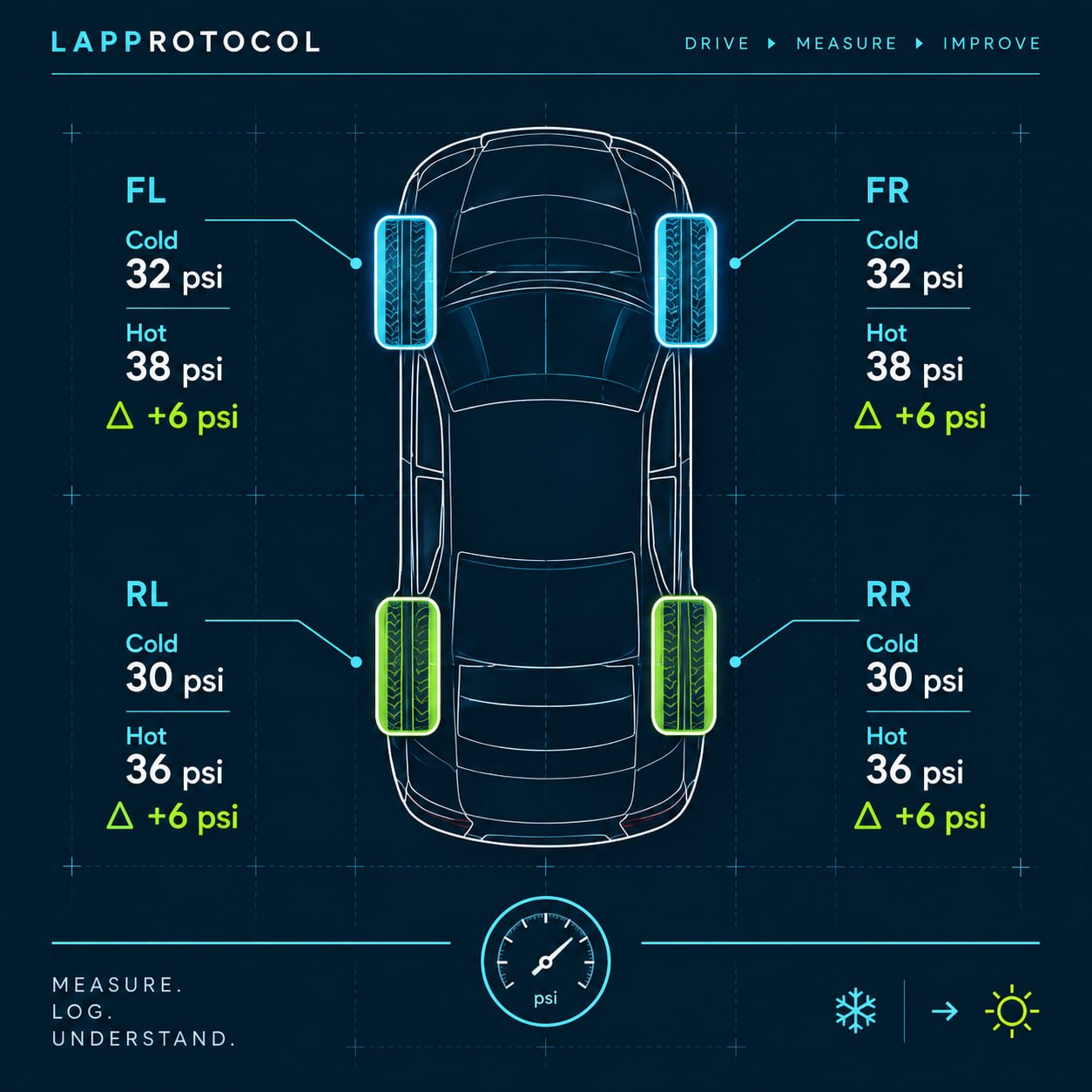
A pressure number copied from another car is not a method. Tyre construction, vehicle weight and geometry, load, surface, weather and driving intensity all affect what a pressure reading means. A useful track-day record starts with the exact tyre and the vehicle’s applicable guidance, then keeps the measurement process consistent enough that one session can be compared with another.
The aim is not to produce a universal “correct PSI for track days”. It is to separate three things that are often mixed together: what you measured, what you think it may mean, and what you decide to test next.
Why tyre-pressure advice often goes wrong
The familiar question is: “What pressures are you running?” It sounds specific, but it leaves out the information needed to interpret the answer. The same displayed pressure can behave differently in a different tyre construction, on a different vehicle, with a different load or on a different day. A cold reading taken at home is not directly interchangeable with a reading taken in a warm paddock. A reading taken immediately after a short session is not necessarily comparable with one taken several minutes later.
The Michelin track-day guide illustrates why the baseline must be tied to the vehicle and tyre guidance. Its starting instruction is to use the car manufacturer’s recommended cold pressure, and its warm-tyre guidance is specific to the manufacturer’s road-use recommendation and Michelin’s stated track-day context. That is product and vehicle guidance, not a universal instruction for every tyre.
Start with the tyre, not a target number
Before the car goes on track, identify the tyre model, construction, size and load rating. Check the current tyre manufacturer’s information and the vehicle or component instructions that apply. If the manufacturer publishes product-specific track-use guidance, record it as product-specific. Do not turn it into a recommendation for a different tyre.
Record the vehicle, tyre specification, date, ambient conditions if available, track conditions, fuel or load context, and the session format. The exact fields will depend on how much you can realistically capture at the circuit. A short, complete record is more valuable than an ambitious form that gets abandoned after one run.
For this article’s intended road-legal performance-tyre and owner-driver track-day context, use the vehicle manufacturer’s specified cold pressure as the documented starting reference unless applicable tyre or event guidance says otherwise. This is not a starting method for dedicated racing slicks or every competition tyre, and it does not override tyre-manufacturer instructions or event requirements.
What cold and hot mean in a record
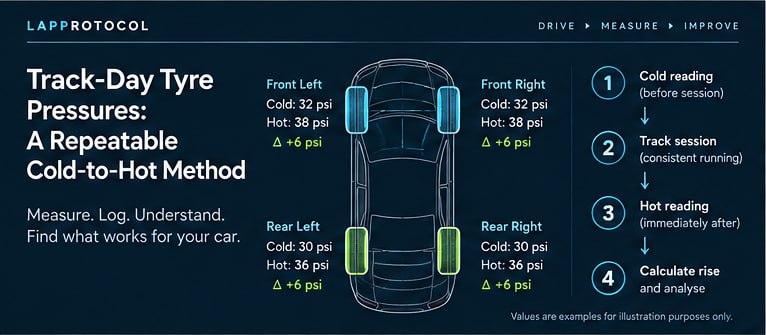
“Cold” should mean the operational state you have defined for the record, not an assumption that the tyre has a perfectly standard temperature. Pirelli describes cold pressure operationally as a reading taken before driving or exposing the tyre to the sun. For many owner-drivers, that means the reading before the session, after the car has been stationary long enough that the four starting readings can be taken under similar conditions. Record when and where that reading was made.
“Hot” should mean a reading taken promptly after the session, using the same process for each corner. It is a snapshot of the tyre after a particular amount of use. It is not a universal temperature state and it does not become comparable simply because the word hot is written beside it.
As the tyre is used, the tyre and the air inside it warm, and pressure commonly rises. Michelin and Pirelli both describe higher readings from warmed tyres, while NASA Speed News makes the practical distinction between cold door-label pressures and higher post-session readings. The size of the change depends on the tyre, vehicle, work done and conditions. Ambient and track temperature can also change during a day.
Timing matters because the reading changes while the tyre and wheel cool. If one corner is checked immediately and another several minutes later, the four values do not describe the same measurement state. The record should make that limitation visible rather than pretending to laboratory precision.
A repeatable measurement process
Before the session
- Confirm the tyre identity and inspect the tread, sidewalls, valves and wheels. Do not use pressure data as a substitute for looking for damage or abnormal condition.
- Check the relevant vehicle, tyre and event guidance.
- Choose one gauge and one display unit. Do not invent an accuracy specification for a consumer gauge. Just use it consistently and treat small differences cautiously.
- Measure all four positions where possible. Record the corner explicitly: front left, front right, rear left and rear right.
- Record the cold value, time, vehicle context, tyre specification and useful weather or surface notes.
A consistent sequence helps. For example, start at front left and continue clockwise, or use the same front-to-rear order every time. The important point is not that one sequence is universally superior. It is that the sequence and timing are repeatable enough to describe the record.
During and immediately after the session
Return to the same measurement location if practical. Measure promptly, using the same gauge, unit and corner order. Record all four hot values rather than only the corner that felt unusual. Note whether the session was short or long, whether the pace changed, whether there was a red flag or cool-down lap, and whether the weather or surface was materially different.
Do not make several unrecorded changes while trying to recover a feeling. If you alter a pressure, write down which corner changed, by how much, why, and whether the change was made before or after the reading. Without that note, the next session may look like a natural result when it actually includes an unknown intervention.
Calculate observed pressure rise
For each recorded corner, calculate:
observed rise = hot pressure - cold pressure
Keep the unit the same on both sides of the subtraction. If the front-left reading is 30 psi cold and 34 psi hot, the observed rise is +4 psi. This is arithmetic describing that measurement pair. It is not a target, a recommended pressure or evidence that 30 psi cold and 34 psi hot is suitable for another car.
Representative teaching data, not a real vehicle test:
| Corner | Cold | Hot | Observed rise |
|---|---|---|---|
| Front left | 30 psi | 34 psi | +4 psi |
| Front right | 30 psi | 35 psi | +5 psi |
| Rear left | 32 psi | 35 psi | +3 psi |
| Rear right | 32 psi | 35 psi | +3 psi |
The table demonstrates the calculation only. It does not recommend any of those values. It also does not tell you whether the car was balanced, whether the tyres were in a suitable operating condition, or what should be changed next.
What the change can tell you
Observed rise gives you a way to describe how that particular tyre and vehicle responded during that particular session. Comparing the four corners may reveal an asymmetry worth investigating. Repeating the same process across comparable sessions may show whether a pattern is persistent or was probably associated with the day’s conditions.
The measurement can support better questions:
- Did one axle or corner show a different response from the others?
- Was the difference repeated under similar conditions?
- Did the tyre, load, fuel, session length or weather change?
- Did the driver report a symptom that occurred at the same time?
- Was the gauge, sequence and timing consistent?
A pattern is a reason to investigate, not proof of a single cause. Corner differences can reflect load distribution, track layout, driving, surface, alignment, suspension, tyre condition, pressure, measurement variation or a combination. NASA’s HPDE guidance discusses visual inspection and tyre-temperature information as additional observations, while also noting that conditions change during the day. Those observations can help define a next test, but they do not turn pressure rise into a self-contained diagnosis.
What it cannot tell you by itself
That distinction is the centre of the method: measurement is not recommendation. The worksheet cannot decide a target, diagnose tyre condition or establish whether a pressure is suitable for continued use. A pressure rise is an observed result; any recommendation requires context, applicable guidance, a safety boundary and a reasoned next test. Where guidance differs, preserve the conditions rather than averaging them into false certainty.
Do not use a universal percentage-rise formula as a replacement for context. A percentage can describe a dataset, but it cannot establish that a given rise is correct for every tyre, vehicle or track. Nor should one observed result silently become a fixed add-or-remove instruction for the next session.
Compare sessions intelligently
The second or third comparable record is often more useful than the first. Keep the basics aligned where possible: tyre specification, gauge, unit, corner sequence, measurement timing and vehicle load. Perfect experimental control is not required, but differences that could change interpretation must be recorded.
A useful session log can include:
- tyre model, size, construction and position
- vehicle and load or fuel context
- cold and hot readings for all four corners
- time of each reading and session length
- ambient and track conditions where available
- driver-reported symptom or handling change
- visible wear or damage observations
- any controlled change and its reason
- what was validated in the next comparable session
If the result is surprising, repeat the measurement process before reaching for a setup conclusion. If the tyre or wheel condition is abnormal, stop treating this as a data problem and arrange a physical inspection.
Common measurement mistakes
Recording only one corner. One value cannot show whether the other axle or opposite corner behaved differently.
Taking readings at inconsistent times. A delayed reading can be cooler and therefore not comparable with a prompt reading.
Treating a feeling as a diagnosis. Understeer, oversteer, vagueness or a “greasy” sensation may be useful symptoms, but none has one guaranteed pressure cause.
Changing several variables together. If pressure, alignment, damping and driving style all change, the next result is harder to interpret. Make one controlled change where the situation allows and record it.
Use the Cold-to-Hot Tyre Pressure Worksheet
The Cold-to-Hot Tyre Pressure Worksheet is a small logging aid for this method. It accepts cold and hot readings in psi or bar, keeps positions that were not fully recorded blank, and calculates the observed rise for complete pairs.
Use the worksheet for arithmetic and record-keeping, then use the relevant guidance and session context for interpretation and any controlled next test. It does not select targets, diagnose tyre condition or prescribe an adjustment.
A practical next-session checklist
Before leaving for the circuit, identify the tyre and check the applicable guidance. At the car, inspect the tyres and wheels, select the gauge and record all four cold values. After the session, measure promptly in the same order and record all four hot values. Calculate the observed rise, note the session and conditions, and record any symptom without calling it a diagnosis.
Before changing anything, ask what the data actually supports. If a change is justified by the applicable guidance and the observed context, change one meaningful variable, write it down, and validate it in another comparable session. If the evidence is incomplete, leave the conclusion conditional. “Not yet confirmed” is a useful result when the record cannot answer the question.
Sources and methodology
This article uses Michelin’s public track day tyre guide for manufacturer-specific baseline, warm-pressure and tyre-condition guidance, and Pirelli’s tyre-pressure check guidance for the operational cold and warm reading distinction. NASA Speed News’ HPDE pressure article supplements this with practical observation and changing-condition context.
The LapProtocol method is symptom, measurement, interpretation, controlled change and validation. The worksheet performs only the defined cold-to-hot logging and subtraction; it does not replace tyre guidance, vehicle instructions, inspection or qualified technical advice.